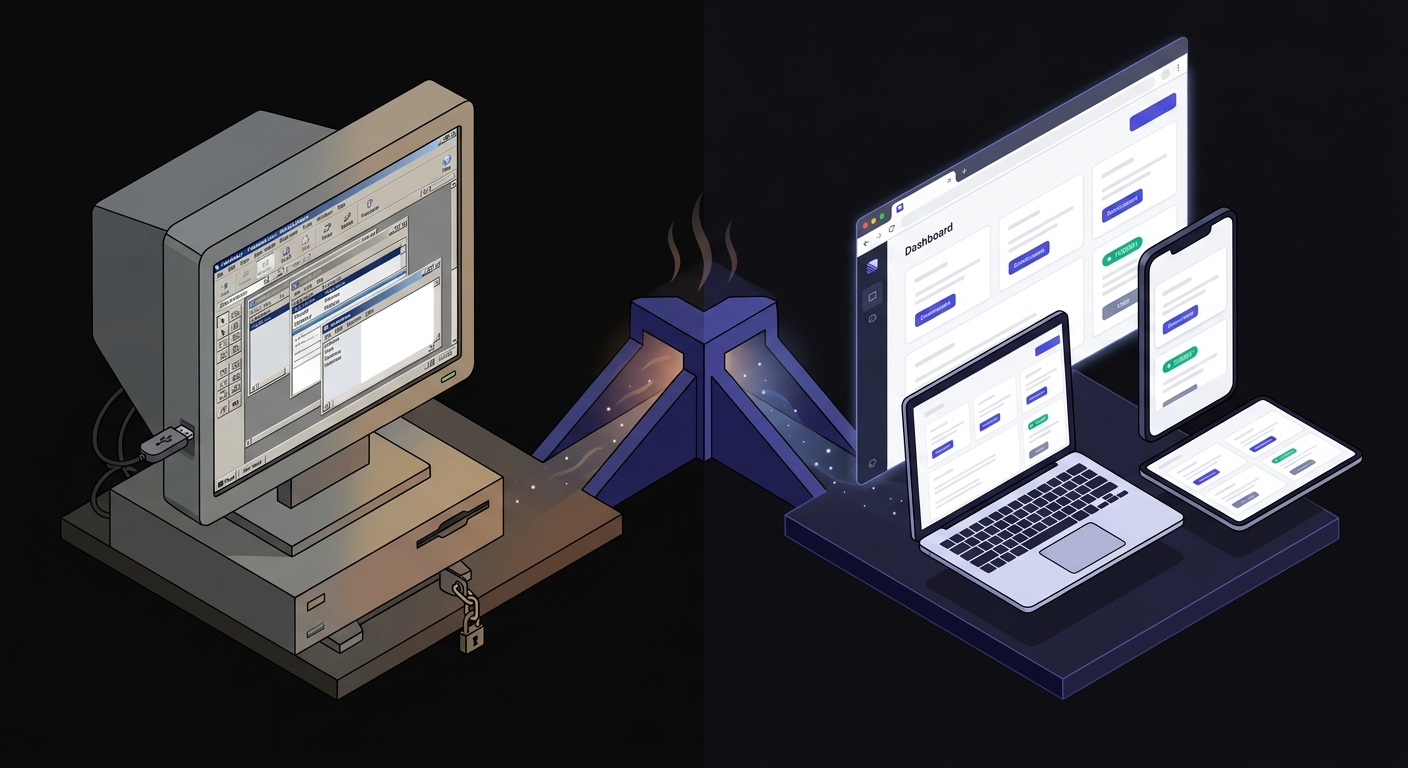
FileMaker was the right choice — ten years ago. Today, it's costing you money, limiting your team, and blocking your growth. We convert your FileMaker app into a modern web application. Clean, fast, and yours to own.
Sound familiar? You're not alone. These are the patterns we see in every FileMaker migration conversation.
FileMaker customisation requires specialists who charge premium rates. A simple new feature spirals into a bloated invoice. You've stopped asking.
Remote access is slow. Mobile doesn't work well. Integrations are brittle. Your team has built workarounds for the workarounds. Expansion feels dangerous.
Your business knowledge is trapped inside a FileMaker database. Moving off feels risky, expensive, and complicated. So you stay — and pay.
Beyond the day-to-day frustrations, there are three fundamental ways FileMaker works against modern businesses — and one more that's becoming impossible to ignore.
Nearly everything has to be built from scratch. Some add-ons and plugins exist, but they're often brittle, expensive, and create more work than they save — fighting against your existing scripts and logic rather than fitting cleanly into them.
Thousands of plug-and-play libraries handle almost anything you can imagine — payments, maps, PDF generation, e-signatures, email, calendars. APIs connect in minutes. You build features, not infrastructure.
You're strictly limited to whatever FileMaker offers. A component system technically exists, but it's so cumbersome to work with that almost nobody actually uses it — resulting in styling scattered across every layout. And when you do try to update a global style, you're stuck manually visiting each individual instance one by one. Interactivity is minimal. Layouts were designed to work for a handful of power users, not a modern workforce.
Full UI component libraries, icon packs, animation systems — all ready to use. Build screens once with shared components. Need to update a button style across the entire app? Find all, replace — done in seconds.
FileMaker was built decades ago to be accessible to non-developers — which made sense then, but has severely crippled the developer experience since. Once you gain any real proficiency, you're constantly blocked by systems that were designed to keep things simple for beginners. The ceiling is very low.
It took until FM25 to support collapsing script step blocks and removing objects from a group without ungrouping everything — features modern IDEs have had for decades. And if you want the latest release, you'll often need to upgrade your OS too. For some businesses, that means new hardware just to stay current on a platform that's already falling behind.
Modern web development has transformed dramatically. What once required deep expertise is now approachable in days. Tooling, documentation, community support, and above all AI — the gap has never been wider in the web's favour.
When a platform adds a script step called Perform JavaScript in Web Viewer, that's not a feature — it's an admission. Rather than solving its own limitations, FileMaker has been steadily grafting web capabilities onto its surface: JavaScript execution for interactivity, JSON support for data exchange, an Execute FileMaker Data API step because REST is simply more capable. These aren't innovations. They're workarounds for problems the platform can't fix from the inside.
Every one of these additions is FileMaker pointing at the web and saying: they figured it out. For every feature FileMaker ships, the web ecosystem adds a hundred — maintained by thousands of contributors, not one vendor's release cycle.
You can go back and forth with an AI assistant about how to solve a problem in FileMaker, but you'll always be the one translating it into FileMaker yourself. That's assuming the AI can even help — documentation on FileMaker is thin, and there are almost no examples in training data for it to learn from.
Even if FileMaker were to add AI-assisted coding, it would struggle enormously with the rigid, proprietary structures at its core. The web world, meanwhile, is moving at a pace FileMaker simply cannot match. Every month you stay on FileMaker, the gap between your system and what's possible widens a little more. The cost of staying isn't just today's invoices — it's everything you won't be able to build tomorrow.
We start with a free call. You walk us through your FileMaker setup — the workflows, the pain points, what works and what doesn't. No documents required, no preparation needed.
If you want to go deeper, we can work from your DDR (Data Design Report) or an exported XML — a technical blueprint FileMaker generates in a few clicks. It contains your data structure and logic, but no actual business records. For teams who prefer it, we're happy to sign an NDA before anything is shared.
We rebuild your application using modern web technologies. Your data model, your logic, your workflows — translated into a fast, maintainable web app. You see progress in weekly demos. No black boxes.
Throughout the entire build we work with mock data — every script, feature and integration is tested without ever touching real business records. Your actual data is only migrated when the app is ready to go live.
Your new app goes live. You own the code, the data, and the infrastructure. No vendor lock-in. No FileMaker license renewal. No expensive specialist on speed dial.
You choose where it's deployed and which services it runs on. We'll make recommendations based on best practices, but every decision is yours. You're always in control.
Your FileMaker app was built around your specific processes. We don't replace it with an off-the-shelf SaaS tool. We rebuild your actual workflows — the ones your team has used for years — in a modern stack that you can grow, extend, and hand to any developer.
Get startedMoving off FileMaker doesn't just fix what's broken today — it unlocks a set of capabilities that simply weren't possible before.
One of FileMaker's strengths was being able to tweak things yourself. You don't lose that. Your new codebase works with modern AI coding tools — small updates, new fields, tweaked workflows are faster and cheaper than ever. I'll show you how to use these tools yourself, or handle changes at rates that reflect the new reality of AI-assisted development.
WebDirect was FileMaker's answer to the web. Slow, expensive, and painful to use. Your new app runs natively in the browser. Build customer portals, partner dashboards, and public-facing tools without per-seat licensing nightmares or the horror of maintaining a WebDirect deployment.
We can add a conversational AI layer to your app — powered by whichever model you choose. Your team asks questions in plain English and gets answers from their own data. No queries, no exports, no spreadsheet wrangling. Your business knowledge, finally accessible.
This isn't always a rip-and-replace. If part of your operation relies on FileMaker for good reasons — production floor terminals, legacy hardware integration, specialist tooling — you don't have to remove it. We migrate what makes sense to the web, and leave the rest. Fewer licenses. Less exposure. More control.
You're not a startup. You're not an enterprise. You're a growing business that built something real on FileMaker — and now you need it to keep growing with you. We work with SMEs across Europe who are ready to move, but need someone who understands where they're coming from.
Is this you? Let's talk
I spent years as a senior consultant at one of the biggest FileMaker consultancy firms in Europe. I've built, extended, and maintained FileMaker systems across dozens of industries. I know exactly where the complexity lives — and how to untangle it.
Since then, I've moved into web technologies and AI — building modern applications with the same attention to data architecture and workflow logic that FileMaker demands. That combination is rare.
Most web developers don't know FileMaker. Most FileMaker developers don't know the modern web.
I do both.
Every FileMaker app is different. So every project is scoped individually after a discovery call. No hourly billing, no inflated change requests. A fixed scope, a fixed price, a clear timeline.
Typical project range
Depending on complexity. Smaller apps can be done for less. We'll tell you honestly after the discovery call.
Rebased is based in Belgium and serves SMEs across Europe. That means your data stays in Europe — on infrastructure governed by European law, run by European companies.
European hosting is a preference, not a hard requirement — but one I take seriously. I'll always default to European providers first.
German cloud infrastructure. Reliable, affordable, and GDPR-compliant. The default choice for hosting your web app.
hetzner.comFrench cloud provider with a strong focus on developer experience and data sovereignty. A solid alternative when the project calls for it.
scaleway.comEuropean serverless platform with edge deployments across EU regions. Used when low-latency or containerised workloads are the right fit.
koyeb.comA FileMaker app contains years of accumulated business logic — your workflows, your rules, your competitive edge. We don't take that lightly.
Here's how we handle it:
Book a free 30-minute discovery call. No commitment. No
sales pitch.
Just an honest look at what's possible
for your business.
No documents required. Just a
conversation.